








Building a Connected Data Foundation for Public Policy
Public policy has always been an exercise in solving complex, interconnected problems. Yet for decades, governments and civic organisations have attempted to solve these modern challenges using fragmented, legacy systems. When housing, healthcare, transit, and social services data live in isolated silos, leaders are left making multi-million-dollar policy decisions using partial information.
Building a connected data foundation for public policy changes this dynamic entirely. By unifying disparate information streams into an active, single source of truth, leaders can move from reactive troubleshooting to proactive, human-centered governance. Here is how we build an agile data foundation that transforms raw administrative metrics into measurable public good.
Why Disconnected Data Cripples Modern Governance
Every day, public sector agencies generate massive amounts of operational data, from traffic patterns and transit usage to school enrolment and public health reports. However, generating data is not the same as leveraging it. When agencies operate on independent databases, critical context falls through the cracks.
The Hidden Costs of Agency Silos
When social services cannot securely interface with housing departments or health statistics, community programs founder. Instead of treating root causes, policies target isolated symptoms. This disconnect leads to inefficient budget allocation, overlapping public programs, and ultimately, eroded public trust.Delayed Reaction Times
Traditional policy analysis often relies on historical reports that are months or even years old by the time they reach executive desks. In times of crisis, such as extreme weather events, economic shifts, or public health emergencies, policy makers cannot afford to drive forward while only looking in the rearview mirror.The Core Pillars of a Public Policy Data Ecosystem
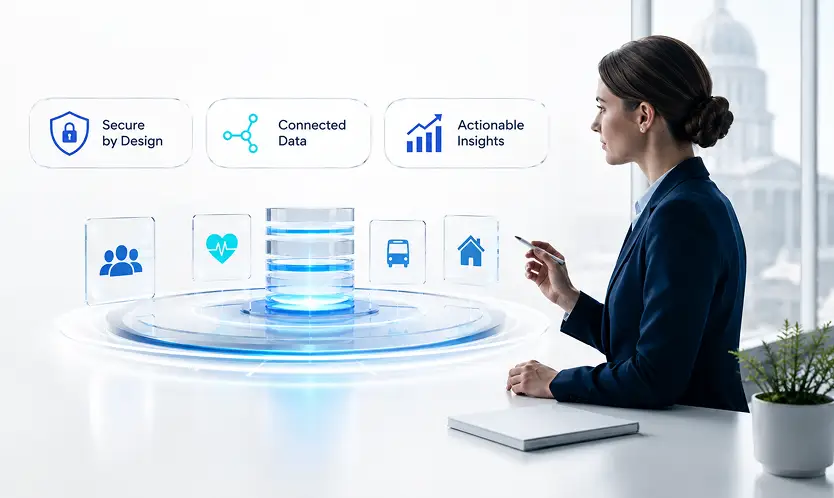
Creating a unified ecosystem does not mean ripping and replacing every legacy tool overnight. Instead, it requires weaving an intelligent connectivity layer across existing systems to curate, secure, and deliver actionable insights.
Pillar 1: Real-Time Integration & Harmonisation
Data arrives in dozens of different formats, unstructured PDF applications, real-time IoT sensors, spatial GIS maps, and structured relational databases. A modern data foundation standardises these inputs into a common schema.Analogy: Think of harmonisation as universal translation. Rather than teaching every system five new languages, we channel all incoming streams into a single, shared vocabulary that every department understands instantly.
Pillar 2: Zero-Trust Security & Granular Privacy
Data sharing in the public sector is bound by stringent regulatory frameworks (such as HIPAA, GDPR, or state-level privacy mandates). A robust data foundation implements role-based access control and dynamic data masking, ensuring that sensitive citizen information remains strictly protected while allowing aggregated, anonymised trends to flow freely to decision-makers.Pillar 3: AI-Ready Architecture
Artificial intelligence and predictive modeling are only as accurate as the underlying data feeding them. Unifying dirty or duplicate records results in biased policy recommendations. By establishing strict data hygiene and deduplication protocols at the foundational level, we pave the way for trustworthy predictive analytics and automated civic workflows.Strategic Advantages of Unified Data in Action
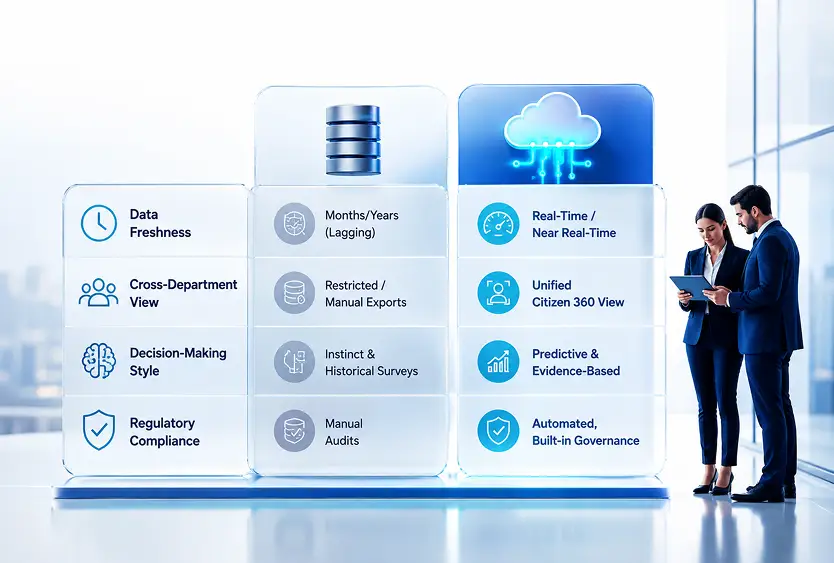
When public sector teams operate from a shared data baseline, the impact is immediately visible across every level of civic engagement.
From Reactive Fixes to Predictive Prevention
Consider urban planning: rather than responding to road congestion after bottlenecks develop, a connected data matrix synthesises public transit feeds, commercial delivery data, and population growth projections. Policy makers can adjust zoning laws or expand transit routes before gridlock occurs.Measuring Real Policy ROI
Historically, evaluating the success of a public program required lengthy academic studies long after funding had expired. With real-time telemetry, leadership can evaluate program adoption week-by-week, making agile adjustments to stretch taxpayer dollars further.Personalized Citizen Experiences
Citizens now expect public services to match the seamless digital interactions they experience in the private sector. A connected infrastructure allows agencies to offer a "Single View of the Customer," meaning a resident only has to update their address or income status once to update all relevant public support portals.Cross-Jurisdictional Collaboration
Regional challenges like environmental management or regional economic development do not stop at city borders. Unified data frameworks enable seamless, secure data-sharing agreements between municipal, state, and national entities.A 4-Step Roadmap for Executive Leaders
Transitioning an organisation toward a unified data strategy requires balancing technological capability with organizational change management.
- Establish Clear Governance Rules: Define data ownership, stewardship protocols, and access permissions across participating agencies from day one.
- Prioritise High-Impact Use Cases: Start small. Identify 1–2 critical policy objectives (e.g., streamlining emergency response times or optimizing affordable housing distribution) to prove value quickly.
- Adopt Interoperable Cloud Platforms: Choose scalable, open architectures that support seamless API integration with both legacy systems and emerging technologies. (Suggested Internal Link: Insert link to Salesforce Data Cloud for Public Sector overview)
- Cultivate a Data-Informed Culture: Empower policy analysts and frontline teams with user-friendly dashboards so data becomes a natural part of daily decision-making, not just an IT responsibility.

Key Takeaways
- Silos hinder progress: Fragmented data creates policy blind spots, inflates costs, and delays response times during critical events.
- Integration over replacement: Modern architecture bridges legacy databases into a unified, secure analytical layer without requiring a complete system overhaul.
- Privacy is paramount: A connected framework must embed zero-trust protocols and data masking directly into its design to maintain public trust.
- AI requires clean foundations: Automated insights and predictive policy models depend entirely on harmonised, accurate inputs.
- Actionable agility: Real-time data moves governance from post-mortem reporting to active, predictive community leadership.
Conclusion: Building the Future of Public Governance
A connected data foundation for public policy is no longer a luxury reserved for future planning, it is an operational requirement for resilient, responsive governance today. When leaders bridge the gap between isolated systems, they gain the clarity needed to make bold, effective choices that directly improve community outcomes. Ready to transform your agency’s data strategy into actionable policy leadership?
< Contact our Public Sector strategy team today to explore our tailored implementation frameworks.